We hear it more often than you might think.
“When I die, I don’t want a funeral.”
Usually, it’s said with the best of intentions.
“I don’t want a fuss.”
“I don’t want everyone standing around being sad.”
“Just cremate me.”
“Don’t waste money on me.”
“Have a drink and remember me.”
And increasingly, people are making those wishes known to their families long before they die.
We believe strongly that people’s wishes matter. But there’s another side to this conversation that is worth talking about.
A funeral isn’t only for the person who has died.
It’s also for the people who remain.
What are we really saying no to?
When someone tells us they don’t want a funeral, it’s worth understanding what they actually mean.
Do they not want a church service?
A hearse?
A casket at the front of a room?
People dressed in black?
A formal ceremony?
Or do they genuinely mean that when they die, they want absolutely nothing to happen?
Those are very different things.
Sometimes what people are rejecting isn’t the idea of saying goodbye at all. They’re rejecting an image of what they think a funeral has to be.
And funerals don’t have to look like that anymore.
There is a space between a traditional funeral and doing nothing
A farewell might be ten people sitting around a kitchen table telling stories.
It might be gathering at home with the person who has died.
It might be taking them back to the family farm.
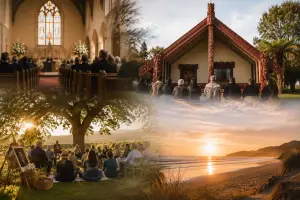
It could be a few words beside the cremator, a gathering at a favourite beach, drinks at the local, a service at a marae, or a large traditional funeral with hundreds of people.
It doesn’t even necessarily have to happen immediately.
The important thing isn’t the format.
It’s creating an opportunity to acknowledge that something significant has happened.
Someone was here.
They mattered.
And now they’re gone.
The people left behind have needs too
This is perhaps the part of funeral planning we don’t talk about enough.
When we’re planning our own funeral, we’re imagining an event we won’t actually attend in the way everyone else will.
Our family will.
Our friends will.
Our grandchildren, colleagues and neighbours might.
They are the people who will wake up the following morning and begin learning how life works without us in it.
A farewell can’t remove their grief.
But gathering, seeing, talking, remembering, crying, laughing and acknowledging the reality of a death can all have meaning.
That’s why we think planning ahead should involve more than simply asking:
“What do I want?”
There’s another valuable question:
“What might the people I love need?”
“No fuss” can still have meaning
If you don’t want a traditional funeral, that’s absolutely okay.
If you don’t want flowers, hymns, a celebrant or a formal service, that’s okay too.
Simple can be beautiful.
Private can be meaningful.
Unconventional can be exactly right.
But perhaps before saying “I don’t want a funeral,” it’s worth having a slightly different conversation with the people closest to you.
Tell them what you don’t want.
Then ask them what they might need.
You may discover that there’s a middle ground that honours both.
Our job isn’t to convince you to have a funeral
At Tong & Peryer, we’re not here to tell families what a funeral should look like.
Sometimes the right choice genuinely is a simple cremation with no service.
Sometimes it’s a full traditional funeral.
And sometimes it’s something that doesn’t particularly look like a “funeral” at all.
Our role is to help people understand the choices available and what those choices might mean — so they can make informed decisions rather than simply following convention.
Or rejecting it.
Because after more than a century of helping Hawke’s Bay families say goodbye, one thing remains remarkably consistent:
When someone dies, the people who love them usually need something.
The challenge is discovering what that something should be.